Represents the global simulation domain (the "world").
More...
#include <world.hpp>
template<
typename T>
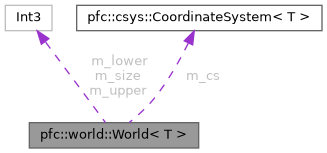
struct pfc::world::World< T >
Represents the global simulation domain (the "world").
The World class defines the size of the global simulation domain and coordinate system. It is a purely functional object with no mutable state, constructed once and immutable thereafter. This design enhances correctness, thread safety, testability, and reproducibility.
Coordinate system is defined via a tag-based programming approach, allowing different coordinate systems (Cartesian, Polar, Cylindrical) without creating a separate class for each. We default to 3D Cartesian as it's most common.
- Template Parameters
-
| T | Coordinate system tag (e.g., CartesianTag) |
- See also
- world_factory.hpp for construction
-
world_queries.hpp for accessing properties
- Examples
- /home/runner/work/OpenPFC/OpenPFC/examples/17_custom_coordinate_system.cpp, /home/runner/work/OpenPFC/OpenPFC/include/openpfc/core/decomposition.hpp, /home/runner/work/OpenPFC/OpenPFC/include/openpfc/results_writer.hpp, /home/runner/work/OpenPFC/OpenPFC/include/openpfc/results_writers/vtk_writer.hpp, /home/runner/work/OpenPFC/OpenPFC/include/openpfc/time.hpp, 01_world_basics.cpp, 02_domain_decomposition.cpp, 02_fft_transforms.cpp, 03_parallel_fft.cpp, 03_simulator_workflow.cpp, 04_diffusion_model.cpp, 05_simulator.cpp, 06_multi_index.cpp, 07_array.cpp, 08_discrete_fields.cpp, Array-style, Basic, Complex, Coordinate-space, Creating, Full, Functional, Integration, Interpolation, MPI, Reading, Simple, world.cpp, and world_strong_types_example.cpp.
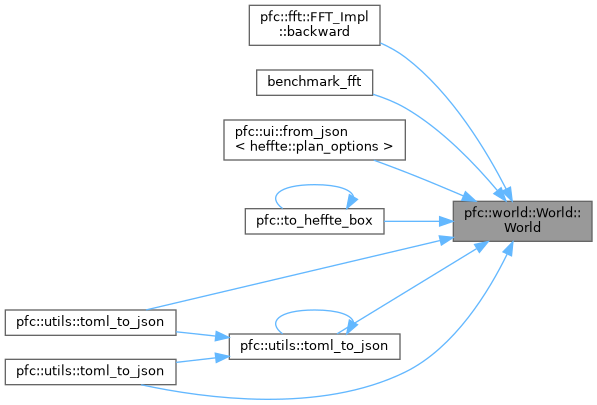
◆ World()
◆ operator!=()
Inequality operator.
- Parameters
-
| other | Another World object. |
- Returns
- True if not equal, false otherwise.
◆ operator==()
Equality operator.
- Parameters
-
| other | Another World object. |
- Returns
- True if equal, false otherwise.
◆ operator<<
Stream output operator.
- Parameters
-
| os | Output stream. |
| w | World object. |
- Returns
- Reference to the output stream.
The documentation for this struct was generated from the following file:
 1.9.8
1.9.8