OpenPFC  0.1.4
Phase Field Crystal simulation framework
Loading...
Searching...
No Matches
pfc::world Namespace Reference

Namespace for decomposition-related classes and functions. More...

Classes

struct  World
 Represents the global simulation domain (the "world"). More...
 

Typedefs

using CartesianWorld = World< CartesianTag >
 Type alias for Cartesian 3D World (most common usage)
 

Functions

template<typename T >
auto create (const World< T > &world, const heffte::box3d< int > &box)
 Construct a new World object from an existing one and a box.
 
template<typename T >
auto to_indices (const World< T > &world)
 
template<typename T >
auto split_world (const World< T > &world, const Int3 &grid)
 
CartesianWorld create (const Int3 &size)
 Create a World object with the specified size and default offset and spacing.
 
CartesianWorld create (const GridSize &size, const PhysicalOrigin &origin, const GridSpacing &spacing)
 Create a World object with strong types for type safety.
 
CartesianWorld create (const Int3 &size, const Real3 &offset, const Real3 &spacing)
 Create a World object with raw arrays (DEPRECATED)
 
CartesianWorld uniform (int size)
 Create uniform grid with unit spacing at origin.
 
CartesianWorld uniform (int size, double spacing)
 Create uniform grid with specified spacing.
 
CartesianWorld from_bounds (Int3 size, Real3 lower, Real3 upper, Bool3 periodic={true, true, true})
 Create grid from physical bounds (automatically computes spacing).
 
CartesianWorld with_spacing (Int3 size, Real3 spacing)
 Create grid with default origin but custom spacing.
 
CartesianWorld with_origin (Int3 size, Real3 origin)
 Create grid with custom origin but unit spacing.
 
template<typename T >
Int3 get_size (const World< T > &world) noexcept
 
template<typename T >
int get_size (const World< T > &world, int index)
 
template<typename T >
size_t get_total_size (const World< T > &world) noexcept
 
const autoget_lower (const CartesianWorld &world) noexcept
 Get the lower bounds of the world.
 
const autoget_lower (const CartesianWorld &world, int index)
 Get the lower bounds of the world in a specific dimension.
 
const autoget_upper (const CartesianWorld &world) noexcept
 Get the upper bounds of the world in a specific dimension.
 
auto get_upper (const CartesianWorld &world, int index)
 Get the upper bounds of the world in a specific dimension.
 
template<typename T >
const autoget_coordinate_system (const World< T > &world) noexcept
 Get the coordinate system of the world.
 
const Real3 & get_spacing (const CartesianWorld &world) noexcept
 
double get_spacing (const CartesianWorld &world, int index) noexcept
 
const Real3 & get_origin (const CartesianWorld &world) noexcept
 
double get_origin (const CartesianWorld &world, int index) noexcept
 
template<typename T >
auto to_coords (const World< T > &world, const Int3 &indices) noexcept
 
template<typename T >
auto to_indices (const World< T > &world, const Real3 &coords) noexcept
 
template<typename T >
double physical_volume (const World< T > &world) noexcept
 Compute physical volume of domain.
 
template<typename T >
bool is_1d (const World< T > &world) noexcept
 Check if domain is 1D (only x-direction has > 1 point)
 
template<typename T >
bool is_2d (const World< T > &world) noexcept
 Check if domain is 2D (x and y have > 1 point, z has 1)
 
template<typename T >
bool is_3d (const World< T > &world) noexcept
 Check if domain is 3D (all dimensions have > 1 point)
 
template<typename T >
int dimensionality (const World< T > &world) noexcept
 Get dimensionality as integer.
 
template<typename T >
Real3 get_lower_bounds (const World< T > &world) noexcept
 Get physical lower bounds (origin corner)
 
template<typename T >
Real3 get_upper_bounds (const World< T > &world) noexcept
 Get physical upper bounds (far corner)
 
template<typename T >
std::array< std::vector< double >, 3 > coordinates (const World< T > &world) noexcept
 

Detailed Description

Namespace for decomposition-related classes and functions.

Function Documentation

◆ create() [1/3]

CartesianWorld pfc::world::create ( const GridSize size,
const PhysicalOrigin origin,
const GridSpacing spacing 
)

Create a World object with strong types for type safety.

This is the preferred API for creating World objects. Strong types (GridSize, PhysicalOrigin, GridSpacing) make the API self-documenting and prevent parameter confusion at compile time.

Parameters
sizeGrid dimensions (number of points per dimension)
originPhysical origin of the coordinate system
spacingPhysical spacing between grid points
Returns
A World object with the specified geometry
Note
Zero overhead - strong types compile away completely
Type-safe - compiler catches parameter order mistakes
// Clear and type-safe
GridSize size({256, 256, 256});
PhysicalOrigin origin({-128.0, -128.0, -128.0});
GridSpacing spacing({1.0, 1.0, 1.0});
auto world = world::create(size, origin, spacing);
// Won't compile if parameters are swapped
// auto bad = world::create(spacing, size, origin); // Compile error!
auto create(const World< T > &world, const heffte::box3d< int > &box)
Construct a new World object from an existing one and a box.
Definition decomposition.hpp:62
Grid dimensions (number of grid points per dimension)
Definition strong_types.hpp:176
Physical origin of coordinate system.
Definition strong_types.hpp:424
Represents the global simulation domain (the "world").
Definition world.hpp:91
See also
GridSize, PhysicalOrigin, GridSpacing in strong_types.hpp
create(Int3, Real3, Real3) for legacy API (deprecated)

◆ create() [2/3]

CartesianWorld pfc::world::create ( const Int3 &  size)

Create a World object with the specified size and default offset and spacing.

Parameters
dimensionsDimensions of the world.
Returns
A World object.

◆ create() [3/3]

CartesianWorld pfc::world::create ( const Int3 &  size,
const Real3 &  offset,
const Real3 &  spacing 
)

Create a World object with raw arrays (DEPRECATED)

Deprecated:
Use create(GridSize, PhysicalOrigin, GridSpacing) for type safety. This overload is ambiguous - it's unclear which Real3 is offset vs spacing. The strong-type API prevents parameter confusion at compile time.
Parameters
sizeGrid dimensions
offsetPhysical offset (origin) of coordinate system
spacingPhysical spacing between grid points
Returns
A World object

Migration guide:

// Old (ambiguous):
auto world = world::create({256, 256, 256}, {0, 0, 0}, {1, 1, 1});
// New (type-safe):
auto world = world::create(
GridSize({256, 256, 256}),
PhysicalOrigin({0, 0, 0}),
GridSpacing({1, 1, 1})
);
See also
create(GridSize, PhysicalOrigin, GridSpacing) for new API

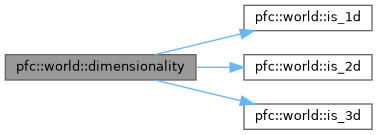
◆ dimensionality()

template<typename T >
int pfc::world::dimensionality ( const World< T > &  world)
inlinenoexcept

Get dimensionality as integer.

Returns 1, 2, or 3 based on how many dimensions have more than one grid point. Returns 0 for degenerate case where all dimensions have size 1.

Parameters
worldWorld instance
Returns
1, 2, 3, or 0 (degenerate) based on active dimensions
auto world2d = world::create({64, 64, 1});
int dim = world::dimensionality(world2d); // Returns 2
int dimensionality(const World< T > &world) noexcept
Get dimensionality as integer.
Definition world_queries.hpp:535

Time complexity: O(1)

Examples
/home/runner/work/OpenPFC/OpenPFC/include/openpfc/core/world_queries.hpp.
Here is the call graph for this function:

◆ from_bounds()

CartesianWorld pfc::world::from_bounds ( Int3  size,
Real3  lower,
Real3  upper,
Bool3  periodic = {truetruetrue} 
)
inline

Create grid from physical bounds (automatically computes spacing).

Parameters
sizeGrid dimensions
lowerLower physical bounds
upperUpper physical bounds
periodicPeriodicity flags (default: all periodic)
Returns
World with computed spacing
Exceptions
std::invalid_argumentif any dimension size <= 0
std::invalid_argumentif any upper bound <= corresponding lower bound
Note
Spacing computed as: dx = (upper - lower) / size for periodic, dx = (upper - lower) / (size - 1) for non-periodic
// 100 cells from 0 to 10 (periodic)
auto w1 = world::from_bounds({100, 100, 100}, {0, 0, 0}, {10, 10, 10});
// Non-periodic in x (different spacing formula)
auto w2 = world::from_bounds({100, 100, 100}, {0, 0, 0}, {10, 10, 10},
{false, true, true});
CartesianWorld from_bounds(Int3 size, Real3 lower, Real3 upper, Bool3 periodic={true, true, true})
Create grid from physical bounds (automatically computes spacing).
Definition world_helpers.hpp:115

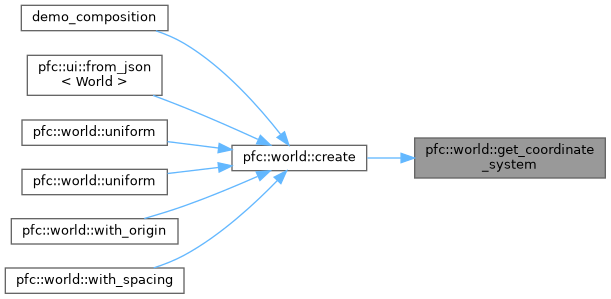
◆ get_coordinate_system()

template<typename T >
const auto & pfc::world::get_coordinate_system ( const World< T > &  world)
inlinenoexcept

Get the coordinate system of the world.

Parameters
wWorld object.
Returns
The coordinate system of the world.
Examples
/home/runner/work/OpenPFC/OpenPFC/include/openpfc/core/decomposition.hpp, and /home/runner/work/OpenPFC/OpenPFC/include/openpfc/core/world_queries.hpp.
Here is the caller graph for this function:

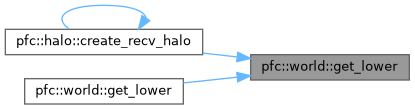
◆ get_lower() [1/2]

const auto & pfc::world::get_lower ( const CartesianWorld world)
inlinenoexcept

Get the lower bounds of the world.

Parameters
wWorld object.
Returns
The lower bounds of the world.
Examples
/home/runner/work/OpenPFC/OpenPFC/include/openpfc/core/decomposition.hpp, /home/runner/work/OpenPFC/OpenPFC/include/openpfc/core/halo_pattern.hpp, and /home/runner/work/OpenPFC/OpenPFC/include/openpfc/core/world_queries.hpp.
Here is the caller graph for this function:

◆ get_lower() [2/2]

const auto & pfc::world::get_lower ( const CartesianWorld world,
int  index 
)
inline

Get the lower bounds of the world in a specific dimension.

Parameters
wWorld object.
iDimension index.
Returns
The lower bound in the specified dimension.
Here is the call graph for this function:

◆ get_lower_bounds()

template<typename T >
Real3 pfc::world::get_lower_bounds ( const World< T > &  world)
inlinenoexcept

Get physical lower bounds (origin corner)

Returns the physical coordinates of the grid point at index (0, 0, 0). This is the lower corner of the domain.

Parameters
worldWorld instance
Returns
Physical coordinates of (0, 0, 0) grid point
auto world = world::create({100, 100, 100}, {-5, -5, 0}, {0.1, 0.1, 0.1});
Real3 lower = world::get_lower_bounds(world); // Returns {-5, -5, 0}
Real3 get_lower_bounds(const World< T > &world) noexcept
Get physical lower bounds (origin corner)
Definition world_queries.hpp:558

Time complexity: O(1)

Examples
/home/runner/work/OpenPFC/OpenPFC/include/openpfc/core/world_queries.hpp.

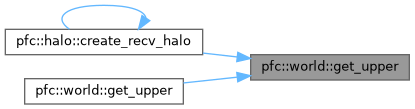
◆ get_upper() [1/2]

const auto & pfc::world::get_upper ( const CartesianWorld world)
inlinenoexcept

Get the upper bounds of the world in a specific dimension.

Parameters
wWorld object.
Returns
The upper bounds of the world.
Examples
/home/runner/work/OpenPFC/OpenPFC/include/openpfc/core/decomposition.hpp, /home/runner/work/OpenPFC/OpenPFC/include/openpfc/core/halo_pattern.hpp, and /home/runner/work/OpenPFC/OpenPFC/include/openpfc/core/world_queries.hpp.
Here is the caller graph for this function:

◆ get_upper() [2/2]

auto pfc::world::get_upper ( const CartesianWorld world,
int  index 
)
inline

Get the upper bounds of the world in a specific dimension.

Parameters
wWorld object.
iDimension index.
Returns
The upper bound in the specified dimension.
Here is the call graph for this function:

◆ get_upper_bounds()

template<typename T >
Real3 pfc::world::get_upper_bounds ( const World< T > &  world)
inlinenoexcept

Get physical upper bounds (far corner)

Returns the physical coordinates of the grid point at the maximum indices (nx-1, ny-1, nz-1). This is the upper corner of the domain.

Parameters
worldWorld instance
Returns
Physical coordinates of (nx-1, ny-1, nz-1) grid point
auto world = world::create({100, 100, 100}, {0, 0, 0}, {0.1, 0.1, 0.1});
Real3 upper = world::get_upper_bounds(world); // Returns {9.9, 9.9, 9.9}
Real3 get_upper_bounds(const World< T > &world) noexcept
Get physical upper bounds (far corner)
Definition world_queries.hpp:578

Time complexity: O(1)

Examples
/home/runner/work/OpenPFC/OpenPFC/include/openpfc/core/world_queries.hpp.

◆ is_1d()

template<typename T >
bool pfc::world::is_1d ( const World< T > &  world)
inlinenoexcept

Check if domain is 1D (only x-direction has > 1 point)

A domain is considered 1D if only the first dimension has more than one grid point.

Parameters
worldWorld instance
Returns
true if only x-direction is active (nx > 1, ny = 1, nz = 1)
auto world1d = world::create({100, 1, 1});
bool is_1d = world::is_1d(world1d); // Returns true
bool is_1d(const World< T > &world) noexcept
Check if domain is 1D (only x-direction has > 1 point)
Definition world_queries.hpp:471

Time complexity: O(1)

Examples
/home/runner/work/OpenPFC/OpenPFC/include/openpfc/core/world_queries.hpp.
Here is the caller graph for this function:

◆ is_2d()

template<typename T >
bool pfc::world::is_2d ( const World< T > &  world)
inlinenoexcept

Check if domain is 2D (x and y have > 1 point, z has 1)

A domain is considered 2D if the first two dimensions have more than one grid point and the third has exactly one.

Parameters
worldWorld instance
Returns
true if x and y directions are active (nx > 1, ny > 1, nz = 1)
auto world2d = world::create({64, 64, 1});
bool is_2d = world::is_2d(world2d); // Returns true
bool is_2d(const World< T > &world) noexcept
Check if domain is 2D (x and y have > 1 point, z has 1)
Definition world_queries.hpp:492

Time complexity: O(1)

Examples
/home/runner/work/OpenPFC/OpenPFC/include/openpfc/core/world_queries.hpp.
Here is the caller graph for this function:

◆ is_3d()

template<typename T >
bool pfc::world::is_3d ( const World< T > &  world)
inlinenoexcept

Check if domain is 3D (all dimensions have > 1 point)

A domain is considered 3D if all three dimensions have more than one grid point.

Parameters
worldWorld instance
Returns
true if all three directions are active (nx > 1, ny > 1, nz > 1)
auto world3d = world::create({32, 32, 32});
bool is_3d = world::is_3d(world3d); // Returns true
bool is_3d(const World< T > &world) noexcept
Check if domain is 3D (all dimensions have > 1 point)
Definition world_queries.hpp:513

Time complexity: O(1)

Examples
/home/runner/work/OpenPFC/OpenPFC/include/openpfc/core/world_queries.hpp.
Here is the caller graph for this function:

◆ physical_volume()

template<typename T >
double pfc::world::physical_volume ( const World< T > &  world)
inlinenoexcept

Compute physical volume of domain.

Returns the total physical volume (or area in 2D, length in 1D) of the simulation domain.

Parameters
worldWorld instance
Returns
Physical volume V = Lx * Ly * Lz where L = spacing * size
Note
For Cartesian coordinates, this is the product of all physical dimensions
Works correctly for 1D, 2D, and 3D domains
auto world = world::create({100, 100, 100}, {0, 0, 0}, {0.1, 0.1, 0.1});
double vol = world::physical_volume(world); // Returns 1000.0
double physical_volume(const World< T > &world) noexcept
Compute physical volume of domain.
Definition world_queries.hpp:449

Time complexity: O(1) Space complexity: O(1)

Examples
/home/runner/work/OpenPFC/OpenPFC/include/openpfc/core/world_queries.hpp.

◆ uniform() [1/2]

CartesianWorld pfc::world::uniform ( int  size)
inline

Create uniform grid with unit spacing at origin.

Most common case: N×N×N grid with spacing=1, origin=(0,0,0).

Parameters
sizeGrid dimensions (same in all directions)
Returns
World with uniform grid
Exceptions
std::invalid_argumentif size <= 0
auto world = world::uniform(64); // 64³ grid, dx=1
CartesianWorld uniform(int size)
Create uniform grid with unit spacing at origin.
Definition world_helpers.hpp:55
Here is the call graph for this function:

◆ uniform() [2/2]

CartesianWorld pfc::world::uniform ( int  size,
double  spacing 
)
inline

Create uniform grid with specified spacing.

Parameters
sizeGrid dimensions (same in all directions)
spacingGrid spacing (same in all directions)
Returns
World with uniform grid and spacing
Exceptions
std::invalid_argumentif size <= 0
std::invalid_argumentif spacing <= 0
auto world = world::uniform(128, 0.5); // 128³ grid, dx=0.5
Here is the call graph for this function:

◆ with_origin()

CartesianWorld pfc::world::with_origin ( Int3  size,
Real3  origin 
)
inline

Create grid with custom origin but unit spacing.

Parameters
sizeGrid dimensions
originPhysical origin
Returns
World with specified size and origin, spacing=1
Exceptions
std::invalid_argumentif any size <= 0
auto world = world::with_origin({64, 64, 64}, {-5.0, -5.0, 0.0});
CartesianWorld with_origin(Int3 size, Real3 origin)
Create grid with custom origin but unit spacing.
Definition world_helpers.hpp:182
Here is the call graph for this function:

◆ with_spacing()

CartesianWorld pfc::world::with_spacing ( Int3  size,
Real3  spacing 
)
inline

Create grid with default origin but custom spacing.

Parameters
sizeGrid dimensions
spacingGrid spacing
Returns
World with specified size and spacing, origin at (0,0,0)
Exceptions
std::invalid_argumentif any size <= 0
std::invalid_argumentif any spacing <= 0
auto world = world::with_spacing({64, 64, 128}, {0.1, 0.1, 0.05});
CartesianWorld with_spacing(Int3 size, Real3 spacing)
Create grid with default origin but custom spacing.
Definition world_helpers.hpp:154
Here is the call graph for this function: