OpenPFC / Operators and their solutions
Use a hierarchy to correct different scales
Solve a manufactured three-dimensional Dirichlet Poisson problem with native geometric multigrid preconditioning.
Download runnable lesson (.zip)
Includes the model, inputs, required headers and a short run guide.
A local relaxation quickly damps some error patterns and slowly damps others. A multigrid hierarchy transfers the remaining error to a coarser representation. This chapter introduces OpenPFC’s serial geometric Multigrid as a preconditioner for a finite-difference Poisson solve. It is independent of the example-owned dense Chebyshev eigensolver.
Manufacture two spatial scales
On \([0,1]^3\) prescribe zero boundary values and choose
\[u=\sin(\pi x)\sin(\pi y)\sin(\pi z) +.2\sin(2\pi x)\sin(3\pi y)\sin(\pi z).\]
For \(-\Delta u=f\), the two terms in f are multiplied by \(3\pi^2\) and \(14\pi^2\), respectively. These continuous formulas are independent of the discrete operator and give a refinement test.
Keep the physical scaling consistent
The native poisson_auxiliary includes the cell-volume factor. Its interior seven-point stencil is \(h(6u_i-\sum_{j\sim i}u_j)\), equal to \(h^3(-\Delta_hu)\). The right-hand side must therefore be \(h^3f\), not f. Boundary rows and loads are projected consistently onto the homogeneous Dirichlet subspace.
const auto action = pfc::solvers::poisson_auxiliary(grid);
pfc::solvers::Multigrid hierarchy(grid, pfc::solvers::poisson_auxiliary);
pfc::solvers::VectorOperations<> ops;
pfc::solvers::KrylovControls controls;
controls.relative_tolerance = 1e-11;
const auto result = pfc::solvers::gmres(
    ops, action, b, u, controls, [&](const auto &r, auto &z, int iteration) {
      hierarchy(r, z, iteration);
    });
if (!result.converged())
  throw std::runtime_error("Multigrid-GMRES did not converge");
Construct the hierarchy once, then reuse its V-cycle inside the native GMRES solve. The default hierarchy uses damped Jacobi smoothing and rediscretized coarse operators. The bounded coarsest problem is solved directly. This serial vector interface is a clear first lesson; it does not claim the distributed or device behavior of other multigrid classes.
Check solver accuracy and discretization separately
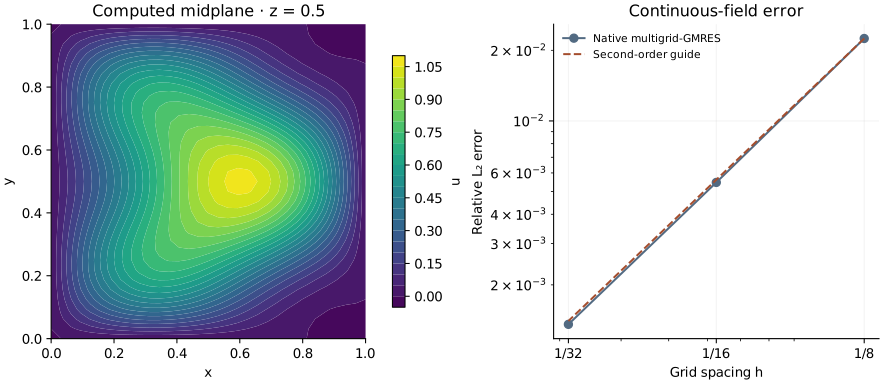
openpfc run model.cpp input.json --launcher=noneThe sizes 9,17,33 include both endpoints and support nested coarsening. results/convergence.csv records relative continuous-field error and solver residuals; each complete field has its own CSV. The independent finite-grid oracle uses the sine-mode eigenvalues
\[\mu_h=\frac4{h^2}\sum_{d=1}^3\sin^2(m_d\pi h/2).\]
Each component’s discrete amplitude is its continuum eigenvalue divided by this discrete eigenvalue. The checks verify that complete discrete answer and the expected second-order convergence toward the continuous one. They do not turn iteration counts on this two-mode load into a general performance claim. Consult the public multigrid contract for coarse-operator and nullspace conventions.
The complete C++ model and starting input are available with this lesson.