OpenPFC / Build a simulation
Two fields, one Runge–Kutta stage
Bind a runtime field group to RK4 and verify that both variables see the same intermediate state.
Download runnable lesson (.zip)
Includes the model, inputs, required headers and a short run guide.
A harmonic oscillator is small enough to understand and demanding enough to expose a staging mistake. At each grid point solve
\[ \begin{gathered} u_t=v, \\ v_t=-u, \\ u(x,0)=\cos x, \\ v(x,0)=0. \end{gathered} \tag{1}\]
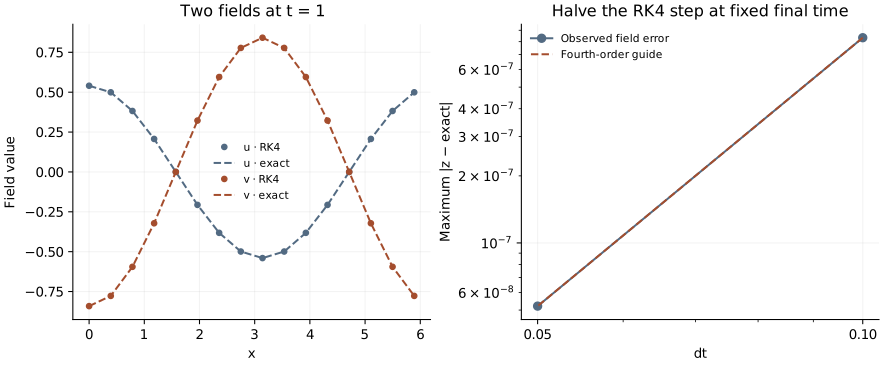
The exact fields are \(u=\cos t\cos x\) and \(v=-\sin t\cos x\). There are no spatial derivatives or halo exchanges in this experiment. Its question is whether a multi-field integrator evaluates all variables at the actual Runge–Kutta stage, rather than reading an old accepted field by accident.
Bind the fields and describe the equations
std::array fields{&u, &v};
auto rhs = [&](double, pfc::sim::steppers::RuntimeFieldRKStepper::Rates rates) {
  std::size_t offset = 0;
  u.for_each_owned([&](int i, int j, int k) {
    rates[0][offset] = v(i, j, k);
    rates[1][offset] = -u(i, j, k);
    ++offset;
  });
};
auto stepper = pfc::sim::steppers::create_runtime(
    fields, dt, pfc::sim::steppers::make_rk4_classical<double>(), rhs, comm);
for (int step = 0; step < steps; ++step) {
  const auto candidate = stepper.attempt(step * dt);
  stepper.commit(candidate);
}
The runtime interface borrows the two fields. During an RHS callback it publishes the intermediate values into those bound fields, lets the callback read them, then restores their accepted storage. The callback fills compact owned-cell rates, in x-fastest order. The final candidate is separate until commit publishes it. Field object addresses and geometry stay fixed for the lifetime of the stepper.
The communicator makes construction, attempts and commits collective. All ranks use the same method and time interval, but their owned boxes can differ. A model with spatial derivatives would prepare the stage’s halos or transforms inside the callback; it could not reuse derivatives of the previous accepted state.
Inspect a discrete answer as well as the continuous one
openpfc run model.cpp input.json --launcher=noneThe input selects steps and dt; the grid is fixed at \(16\times4\times4\). Use two ranks with the usual CLI MPI options. Every final owned value is written to results/oscillator_rank_<rank>.csv with its global index.
For a particularly sharp independent check, combine the variables as \(z=u+iv\). Then \(z'=-iz\). Classical RK4 advances it by
\[R(-ih)=\sum_{j=0}^4\frac{(-ih)^j}{j!}.\]
The tests compare every sample with \(R(-ih)^m\cos x\) and also with the continuous solution. At fixed final time, halving \(h\) should reduce the leading global error by about sixteen. Keeping the old field inside an RHS callback would fail this test despite producing plausible curves. See the public runtime field RK contract for padding, rollback and collective admission details.
The complete C++ model and starting input are available with this lesson.