OpenPFC  0.1.4
Phase Field Crystal simulation framework
Loading...
Searching...
No Matches
kspace.hpp File Reference

K-space (Fourier space) helper functions for spectral methods. More...

#include <array>
#include <cmath>
#include <openpfc/constants.hpp>
#include <openpfc/core/world.hpp>
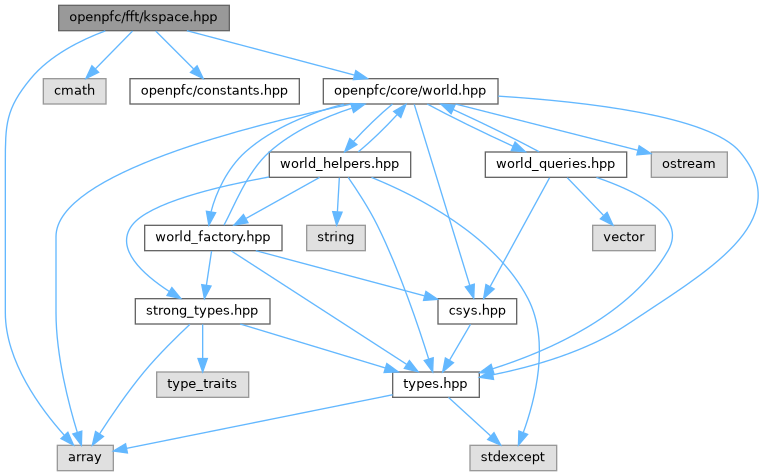
Include dependency graph for kspace.hpp:
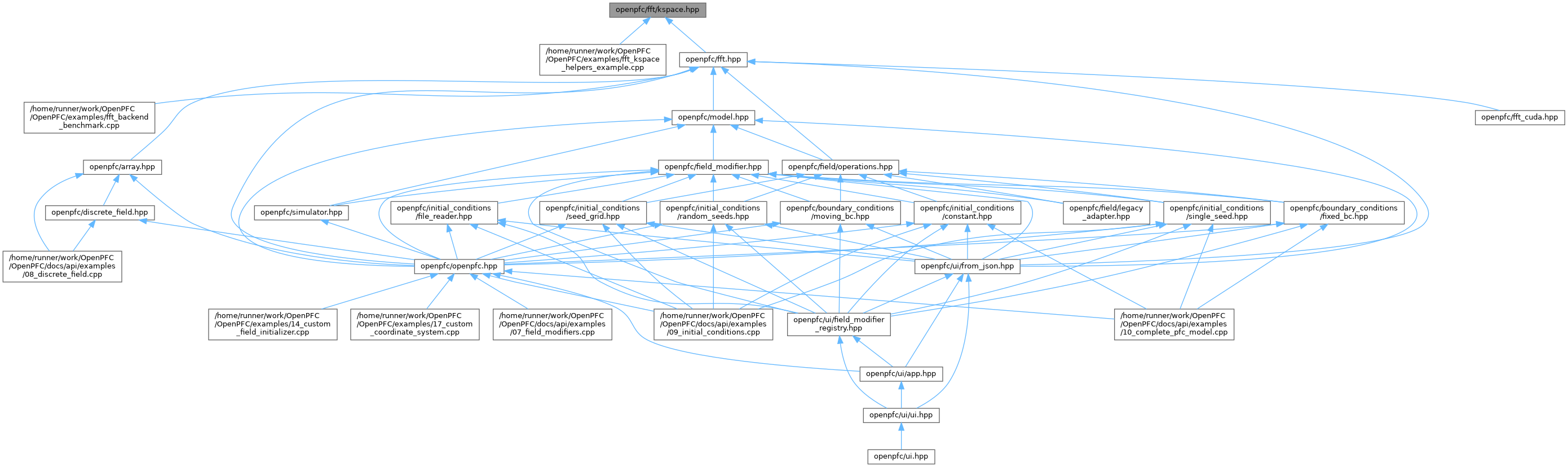
This graph shows which files directly or indirectly include this file:

Go to the source code of this file.

Functions

template<typename T >
std::array< double, 3 > pfc::fft::kspace::k_frequency_scaling (const world::World< T > &world) noexcept
 Compute frequency scaling factors for each dimension.
 
double pfc::fft::kspace::k_component (int index, int size, double freq_scale) noexcept
 Compute k-space wave vector component with Nyquist folding.
 
double pfc::fft::kspace::k_laplacian_value (double ki, double kj, double kk) noexcept
 Compute Laplacian operator value -k² in Fourier space.
 
double pfc::fft::kspace::k_squared_value (double ki, double kj, double kk) noexcept
 Compute squared magnitude k² = k_x² + k_y² + k_z².
 

Detailed Description

K-space (Fourier space) helper functions for spectral methods.

This file provides zero-cost helper functions for computing wave vector components in Fourier space for FFT-based spectral methods. These functions encapsulate the standard frequency scaling and Nyquist folding logic that is duplicated across 120+ lines in multiple examples.

The problem: Every spectral method example contains the same 30-line pattern:

// Duplicated in 04_diffusion_model.cpp, 12_cahn_hilliard.cpp, etc.
double pi = std::atan(1.0) * 4.0;
double fx = 2.0 * pi / (spacing[0] * size[0]);
double fy = 2.0 * pi / (spacing[1] * size[1]);
double fz = 2.0 * pi / (spacing[2] * size[2]);
for (int k = o_low[2]; k <= o_high[2]; k++) {
for (int j = o_low[1]; j <= o_high[1]; j++) {
for (int i = o_low[0]; i <= o_high[0]; i++) {
double ki = (i <= size[0] / 2) ? i * fx : (i - size[0]) * fx;
double kj = (j <= size[1] / 2) ? j * fy : (j - size[1]) * fy;
double kk = (k <= size[2] / 2) ? k * fz : (k - size[2]) * fz;
double kLap = -(ki * ki + kj * kj + kk * kk);
// ... use kLap ...
}
}
}

The solution: Extract reusable helpers:

auto [fx, fy, fz] = k_frequency_scaling(world);
for (int k = o_low[2]; k <= o_high[2]; k++) {
for (int j = o_low[1]; j <= o_high[1]; j++) {
for (int i = o_low[0]; i <= o_high[0]; i++) {
double ki = k_component(i, size[0], fx);
double kj = k_component(j, size[1], fy);
double kk = k_component(k, size[2], fz);
double kLap = k_laplacian_value(ki, kj, kk);
// ... use kLap ...
}
}
}

All functions are inline, noexcept, and zero-cost abstractions that compile to identical machine code as the manual implementation.

See also
core/world.hpp for World coordinate system
fft.hpp for FFT interface
constants.hpp for mathematical constants (two_pi)
Author
OpenPFC Contributors
Date
2025-11-23

Function Documentation

◆ k_component()

double pfc::fft::kspace::k_component ( int  index,
int  size,
double  freq_scale 
)
inlinenoexcept

Compute k-space wave vector component with Nyquist folding.

Converts a grid index to the corresponding wave vector component, handling the Nyquist frequency folding that occurs in real-to-complex FFTs.

FFT convention:

  • Indices 0 to size/2: Positive frequencies k = index * freq_scale
  • Indices > size/2: Negative (aliased) frequencies k = (index-size) * freq_scale
Parameters
indexGrid index (0 to size-1)
sizeDomain size in this dimension
freq_scaleFrequency scaling factor (from k_frequency_scaling)
Returns
Wave vector component in rad/unit_length
Note
This is a zero-cost abstraction (inline, noexcept)
Handles both positive and negative frequencies correctly
Replaces: double ki = (i <= size / 2) ? i * fx : (i - size) * fx;
int Lx = 128;
double fx = two_pi / (0.1 * Lx);
double k0 = k_component(0, Lx, fx); // 0.0 (DC component)
double k1 = k_component(1, Lx, fx); // 1*fx (first mode)
double k64 = k_component(64, Lx, fx); // 64*fx (Nyquist)
double k127 = k_component(127, Lx, fx); // -1*fx (negative)

Time complexity: O(1) Space complexity: O(1)
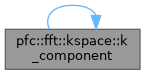
Here is the call graph for this function:
Here is the caller graph for this function:

◆ k_frequency_scaling()

template<typename T >
std::array< double, 3 > pfc::fft::kspace::k_frequency_scaling ( const world::World< T > &  world)
inlinenoexcept

Compute frequency scaling factors for each dimension.

Calculates f = 2π / (spacing * size) for each dimension, which converts grid indices to wave vector components in Fourier space.

In spectral methods using FFT, derivatives in real space become multiplications by wave vectors in Fourier space. The frequency scaling establishes the relationship between grid indices and physical wave numbers.

Template Parameters
TWorld coordinate system type (e.g., CartesianTag)
Parameters
worldSimulation world containing grid size and spacing
Returns
Array of frequency scaling factors [fx, fy, fz] in rad/unit_length
Note
This is a zero-cost abstraction (inline, noexcept)
Works correctly for 1D, 2D, and 3D domains
Replaces: double fx = 2.0 * pi / (spacing[0] * size[0]);
auto world = world::uniform(128, 0.1);
auto [fx, fy, fz] = k_frequency_scaling(world);
// fx = fy = fz = 2π / (0.1 * 128) ≈ 0.490873...

Time complexity: O(1) Space complexity: O(1)
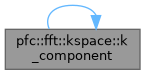
Here is the call graph for this function:
Here is the caller graph for this function:

◆ k_laplacian_value()

double pfc::fft::kspace::k_laplacian_value ( double  ki,
double  kj,
double  kk 
)
inlinenoexcept

Compute Laplacian operator value -k² in Fourier space.

Calculates -(k_x² + k_y² + k_z²), the Fourier representation of the Laplacian operator ∇². Used in diffusion, heat, and phase-field equations.

Mathematical relationship:

  • Real space: ∇² = ∂²/∂x² + ∂²/∂y² + ∂²/∂z²
  • Fourier space: ∇² ↔ -k² = -(k_x² + k_y² + k_z²)

The negative sign is conventional, making the Laplacian negative definite.

Parameters
kiWave vector x-component
kjWave vector y-component
kkWave vector z-component
Returns
Laplacian operator value -k² ≤ 0
Note
This is a zero-cost abstraction (inline, noexcept)
Returns negative value for non-zero k
Returns exactly 0.0 for DC component (ki=kj=kk=0)
Replaces: double kLap = -(ki * ki + kj * kj + kk * kk);
// Diffusion equation: ∂u/∂t = D∇²u
// In Fourier space: ∂û/∂t = D(-k²)û
double ki = k_component(i, Lx, fx);
double kj = k_component(j, Ly, fy);
double kk = k_component(k, Lz, fz);
double kLap = k_laplacian_value(ki, kj, kk);
// Implicit time stepping
opL[idx] = 1.0 / (1.0 - D * dt * kLap);

Time complexity: O(1) Space complexity: O(1)
Here is the call graph for this function:
Here is the caller graph for this function:

◆ k_squared_value()

double pfc::fft::kspace::k_squared_value ( double  ki,
double  kj,
double  kk 
)
inlinenoexcept

Compute squared magnitude k² = k_x² + k_y² + k_z².

Calculates the positive squared magnitude of the wave vector, useful for higher-order operators, filtering, and wave number magnitudes.

Mathematical relationships:

  • k² = k_x² + k_y² + k_z² = |k|²
  • |k| = √k² (wave number magnitude)
  • Biharmonic: ∇⁴ ↔ k⁴ = (k²)²
  • Related to Laplacian: k_laplacian_value(ki, kj, kk) = -k_squared_value(ki, kj, kk)
Parameters
kiWave vector x-component
kjWave vector y-component
kkWave vector z-component
Returns
k² = k_x² + k_y² + k_z² ≥ 0
Note
This is a zero-cost abstraction (inline, noexcept)
Returns positive value (magnitude squared)
Replaces: double k2 = ki * ki + kj * kj + kk * kk;
double ki = k_component(i, Lx, fx);
double kj = k_component(j, Ly, fy);
double kk = k_component(k, Lz, fz);
double k2 = k_squared_value(ki, kj, kk);
double k_mag = std::sqrt(k2); // Wave vector magnitude
double k4 = k2 * k2; // Biharmonic operator

Time complexity: O(1) Space complexity: O(1)
Here is the call graph for this function:
Here is the caller graph for this function: